
21 July 2026
Last week, Bank of England (“BoE”) Governor Andrew Bailey highlighted clear financial stability risks, noting the central bank must monitor price inflation hitting 3.2%. Consequently, policymakers are facing renewed monetary tightening expectations, especially as money markets now fully price further increases and anticipate upcoming hikes if oil volatility persists. Elsewhere, the British economy grew marginally in May by 0.1%, meeting economists' expectations despite high domestic energy costs persistently constraining broader private sector output. Major investors expect the BoE to slow or halt sales of long-term government debt this autumn as quantitative tightening inflates borrowing costs.
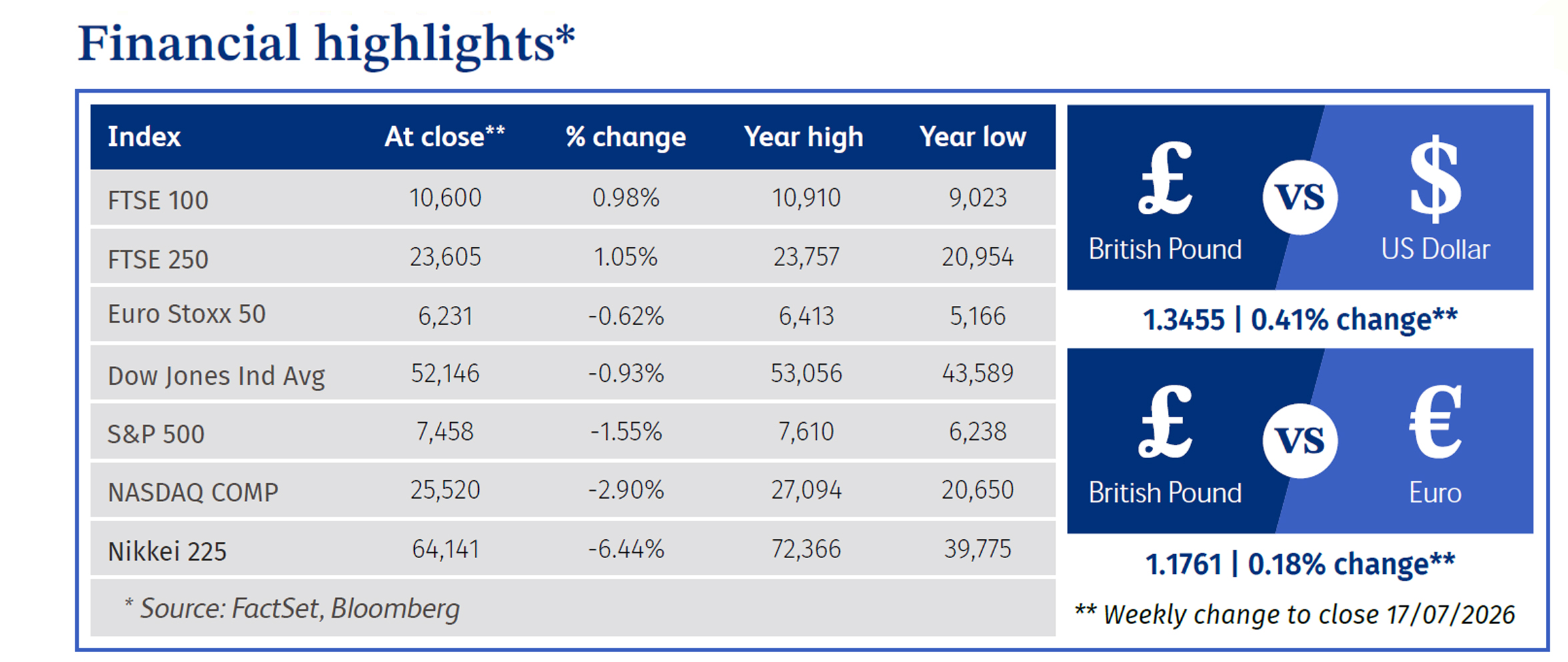
In Equities, the FTSE 100 rose last week, outperforming due to its low exposure to the global tech sector and a market rotation into defence and utility stocks. Market sentiment was further buoyed by newfound political clarity. Running unchallenged, Andy Burnham won the Labour leadership and was sworn in as Prime Minister on the 20th July, immediately revealing his cabinet alongside a major tax reform strategy aimed at tackling regional inequality. Meanwhile, the OECD (Organisation for Economic Co-operation and Development) urged the new government to maintain fiscal discipline amid high debt and rising tax burdens, notably recommending the abolition of the pension triple lock, a move that could save £60 billion, or 2% of GDP, over the long term.
Across the Atlantic, geopolitics moved back into consideration as Iran tensions ramped up again with the latest hostilities between the US and Tehran. This heightened tension was further fuelled by reports that President Donald Trump is considering a massive offensive on Iran, with his administration notifying Israel that it is sending dozens of additional refuelling planes ahead of possible military operations, which helped push WTI crude up substantially. Meanwhile, announcements from the Federal Reserve (“Fed”) maintained a cautious tone, despite a cooler than expected June inflation report, where headline CPI fell to 3.5% year over year (down from 4.2% in May). Chair of the Fed Kevin Warsh testified there is "still work to do" and argued that the AI supply shock is happening faster than anticipated.
In markets, major US equities were lower this week, with the S&P 500 and Nasdaq falling to break previous weekly gains. The Dow Jones Industrial Average also fell 0.93% as a momentum selloff aggressively dragged down semiconductors, memory and AI infrastructure names. Big Tech traded mostly weaker, with Meta dropping 3.5% and IBM plummeting 26% in its worst week on record after noting sales fell short due to customers shifting spend toward AI computing. However, the momentum selloff was met with a rotation into select cyclicals, regional banks and the Energy sector, which broadly outperformed.
Finally, the UK housing market faces renewed borrowing pressures rather than a period of relief. Major lenders have recently raised fixed-rate mortgages by up to 0.35% as Middle East hostilities drive up swap rates, and further cost increases for borrowers are likely.
Metlen Energy & Metals is a multinational industrial conglomerate that focuses primarily on the energy and metallurgy sectors, with operations spanning power generation, renewable energy development and metal production. Last week, the company's stock surged 10.6% over the trading week, closing at €44.36 on July 17, 2026. The company's strong performance was primarily due to a bounce back from last week’s sell off, investors seemed to digest the news and conclude that it was overdone.
Kingfisher is a major European home improvement and DIY retail group that operates over 1,900 stores across seven countries under well-known banners such as B&Q, and Screwfix. Last week, the company's stock experienced a strong surge, climbing 10.5% to close at 304.2p on July 17, 2026. This impressive performance was due to the market supposedly looking beyond recent economic gloom and pricing in a recovery for the housing market and therefore the home improvement sector. This was further helped by the company's announcement of launching the £50 million second tranche of its ongoing share repurchase programme.
Antofagasta, a copper mining company, saw its stock price drop 7.60% to £34.91p, on July 17, 2026 due to a combination of disappointing operational updates and a broader sector sell-off. The downward pressure began when the company released a Q2 production report showing a 9.5% decline in first-half copper output, leaving investors sceptical about its ability to meet full-year targets. Finally, a sector-wide retreat in metals prices triggered by weak economic data out of China dragged down the copper market, forcing investors to rapidly reassess prices for mining stocks.

Market Commentary prepared by Walker Crips Investment Management Limited.
This publication is intended to be Walker Crips Investment Management's own commentary on markets. It is not investment research and should not be construed as an offer or solicitation to buy, sell or trade in any of the investments, sectors or asset classes mentioned. The value of any investment and the income arising from it is not guaranteed and can fall as well as rise, so that you may not get back the amount you originally invested. Past performance is not a reliable indicator of future results. Movements in exchange rates can have an adverse effect on the value, price or income of any non-sterling denominated investment. Nothing in this document constitutes advice to undertake a transaction, and if you require professional advice you should contact your financial adviser or your usual contact at Walker Crips. Walker Crips Investment Management Limited is authorised and regulated by the Financial Conduct Authority (FRN:226344) and is a member of the London Stock Exchange. Registered office: 128 Queen Victoria Street, London, EC4V 4BJ. Registered in England and Wales number 4774117.



Important Note
No news or research content is a recommendation to deal. It is important to remember that the value of investments and the income from them can go down as well as up, so you could get back less than you invest. If you have any doubts about the suitability of any investment for your circumstances, you should contact your financial advisor.

The value of investments can fall as well as rise. Investors may get back less than invested. Past performance is not a reliable indicator of future results.
The value of investments can fall as well as rise. Investors may get back less than invested.