

4 August 2026
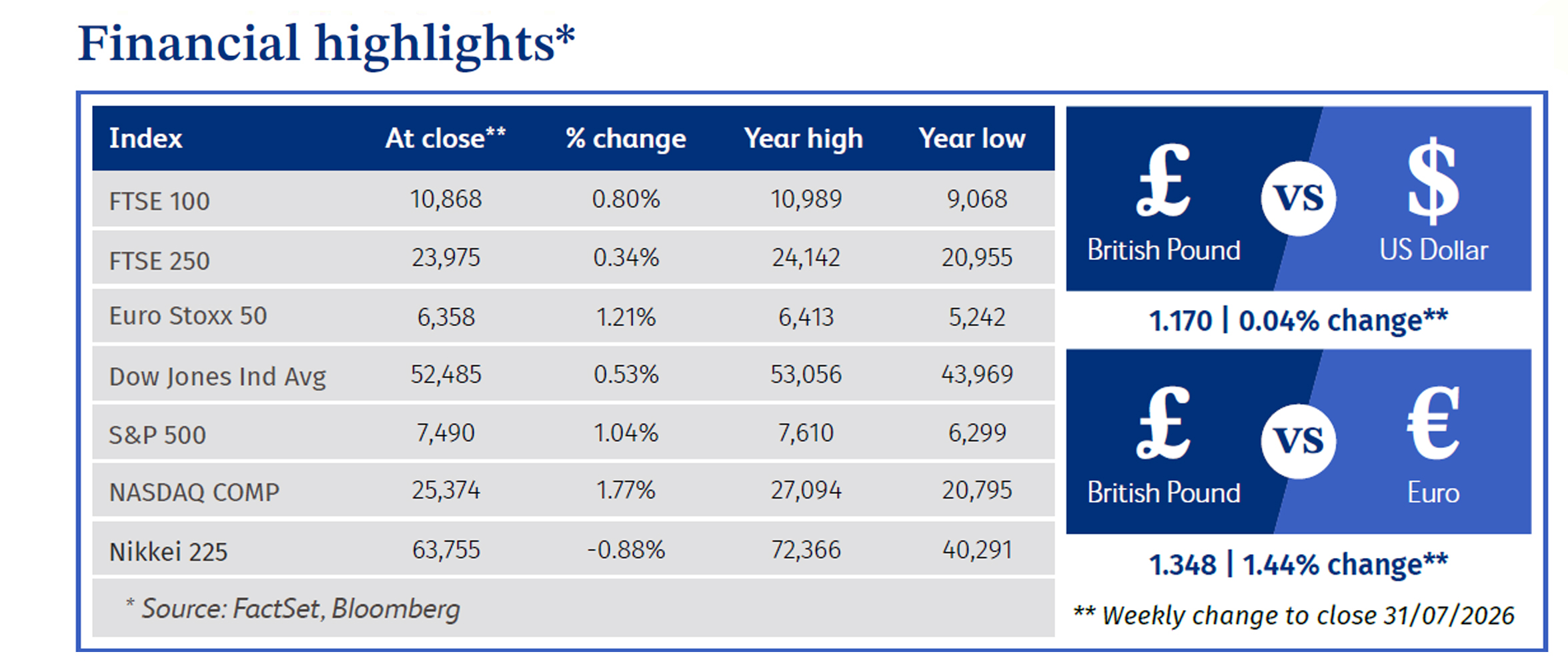
All eyes were on the Bank of England (“BoE”) on Thursday for its latest interest rate decision. The Monetary Policy Committee decided to hold the rate at 3.75%. This dovish stance comes after a split six versus three vote, where investors placed greater weight on the cautious remarks from Governor Andrew Bailey. The BoE remains alert over supply shocks such as oil volatility, food inflation, the easing of price pressures, which fell 0.9%, and a drop in public inflation expectations. Consumers are now drawing down Covid pandemic-era savings to help absorb the current living costs, which in turn is supporting modest retail resilience and pushing business confidence to a four-month-high. Some forecasters are now warning that persistent geopolitical friction and supply risks could weigh on economic expansion well into 2027, meaning the rate path remains complicated.
In Downing Street (and “No.10 North”), the new Prime Minister, Andy Burnham, has outlined a major fiscal decentralisation agenda as he is proposing to empower regional mayors with direct tax retention and private borrowing authority for infrastructure. Seeking to reassure markets on spending, Burnham committed to current fiscal rules, while simultaneously announcing an £8.4 billion investment in the BAE Systems submarine programme to boost regional jobs, whilst also adhering to the previous cabinet defence spending pledge. However, fiscal challenges do persist, with some independent analysts estimating these broader pledges could cost up to £63 billion by 2030 against a £24 billion Treasury gap. Geopolitical risks are also increasing as the joint Anglo-American effort to form a naval coalition in the Strait of Hormuz drew direct warnings from Tehran.
In the UK markets, gilt yields remained volatile as traders grew anxious over the £24 billion Treasury gap and the potential debt issuance required to fund the new government's policy pledges. BP dominated corporate news as the company announced its intention to sell off its North Sea assets following windfall tax hikes, in turn sparking some questions on London-listed equities. On the regulatory front, the Financial Conduct Authority (“FCA”) moved to both modernise and protect City infrastructure with plans for a consolidated trading tape to boost liquidity, while the BoE probed prime brokers over highly leveraged bets on Asian artificial intelligence (“AI”) stocks, highlighting the systemic anxieties.
Across the pond, US equities saw modest gains, as the market concentrated back into heavyweights in technology. The tech-heavy Nasdaq and broader capitalisation-weighted indices outperformed their equal-weight counterparts, recovering from an early-week sell-off in semiconductors and AI infrastructure. In treasuries, investors sold longer-term US debt, pushing yields higher. Gold gained and oil fell on planned Organisation of the Petroleum Exporting Countries (“OPEC”) output increases, while President Donald Trump signalling a pause in Iranian strikes eased geopolitical anxiety. Sentiment was also tested by the Federal Reserve, where Chair Kevin Warsh maintained interest rates but unsettled traders by withholding forward guidance. In corporate news, robust cloud growth at Microsoft and Amazon boosted sentiment, whilst Meta and Apple dragged amid supply constraints and AI spending concerns.
Sage Group, an accounting, payroll and HR software provider, surged 13.40% over the week to stand at 973 pence per share following strong fiscal results and double-digit revenue growth. Investors were reassured by third-quarter revenue growth accelerating to 12% and cloud subscription revenue reaching 84% of total group sales. The update alleviated widespread market anxiety that rapid artificial intelligence advances might disrupt traditional software vendors. Instead, Sage demonstrated that AI rollouts are actively accelerating demand. Reaffirmed full-year organic growth guidance of over 9% and expanding operating margins bolstered investor confidence in the predictability of its high-margin, subscription-led business model.
Burberry Group, a British luxury fashion house, saw its shares jump 11.19% last week to close at 1,187.50 pence following strategic stake-building from key institutional investors. Frasers Group disclosed a potential 4.2% voting interest via put options, while Norges Bank, the central bank of Norway, also adjusted its holdings, signalling institutional confidence. This buying activity builds on a fundamental recovery under Chief Executive Joshua Schulman, whose cost-cutting measures and focus on "timeless British luxury" helped deliver a 5% increase in first-quarter comparable retail sales. Double-digit growth in the Americas and Greater China suggests the brand's turnaround strategy is gaining traction.
Rentokil Initial, a pest control and hygiene management company, tumbled 19.06% last week to 344.8 pence after management warned of slowing momentum in its crucial North American market. Despite first-half revenue rising 6.7%, investor confidence was shaken by late-July trading weakness in its core US market, which accounts for nearly 60% of revenues. Market sentiment soured further on Chief Executive Mike Duffy’s admission that the firm is failing to leverage its scale following the major Terminix acquisition. Concerns over sluggish UK housing activity and a strategic pivot prioritising sales volume over short-term profit margins prompted investors to aggressively price in execution risk.

Market Commentary prepared by Walker Crips Investment Management Limited.
This publication is intended to be Walker Crips Investment Management's own commentary on markets. It is not investment research and should not be construed as an offer or solicitation to buy, sell or trade in any of the investments, sectors or asset classes mentioned. The value of any investment and the income arising from it is not guaranteed and can fall as well as rise, so that you may not get back the amount you originally invested. Past performance is not a reliable indicator of future results. Movements in exchange rates can have an adverse effect on the value, price or income of any non-sterling denominated investment. Nothing in this document constitutes advice to undertake a transaction, and if you require professional advice you should contact your financial adviser or your usual contact at Walker Crips. Walker Crips Investment Management Limited is authorised and regulated by the Financial Conduct Authority (FRN:226344) and is a member of the London Stock Exchange. Registered office: 128 Queen Victoria Street, London, EC4V 4BJ. Registered in England and Wales number 4774117.




Important Note
No news or research content is a recommendation to deal. It is important to remember that the value of investments and the income from them can go down as well as up, so you could get back less than you invest. If you have any doubts about the suitability of any investment for your circumstances, you should contact your financial advisor.

The value of investments can fall as well as rise. Investors may get back less than invested. Past performance is not a reliable indicator of future results.
The value of investments can fall as well as rise. Investors may get back less than invested.


